
Ask rediffGURU and PF expert Milind Vadjikar your insurance, stocks, mutual fund and personal finance-related questions.

AI-driven and deepfake-enabled cyberattacks are anticipated to become increasingly prevalent in 2025 with sectors like healthcare and finance most prone targets, according to a recent report. The India Cyber Threat Report 2025 by the Data Security Council of India (DSCI) and Seqrite, spotlighted the evolving tactics of cybercriminals and the rise of AI-driven attacks as a major concern. "Artificial Intelligence (AI) will be used to develop highly sophisticated phishing campaigns utilising deepfake technology and personalised attack vectors, making them harder to detect.

The number of frauds in the banking sector during the first half of the current financial year has increased substantially to 14,483 cases, although the amount involved is only 14.9 per cent of the previous year's amount, according to a RBI report. The report on Trend and Progress of Banking in India 2022-23, underlined the need to protect the banking system and the payments system from the risks of fraud and data breaches emanating from cyber threats. As many as 14,483 frauds were reported involving an amount of Rs 2,642 crore in the first half of current financial year, as compared to 5,396 cases (Rs 17,685 crore) in the same period a year ago.
.jpg)
Of the 11 licence holders, only eight remain in the fray as concerns about profitability and rising competition are making them think twice before jumping in.

Last year, the software giant launched a cloud adoption programme for SMBs.

Flipkart-backed super.money is on an expansion spree and plans to expand its range of offerings in credit and wealth management after launching its operations in July this year. The Bengaluru-based fintech company is on track to roll out credit products such as credit on Unified Payments Interface (UPI), unsecured credit cards, and personal loans within the first half of the next calendar year (2025).

Debt mutual fund (MF) schemes are set to register the best calendar year (CY) performance in the last four years despite no changes in the interest rate. An analysis of one-year performance of debt funds show that many of the schemes are set to deliver double-digit returns in CY 2024.

'If it doesn't, it will continue with measures to infuse liquidity, signalling a new cycle,' predicts Tamal Bandyopadhyay.

Sources said the equipment is being brought to India through both sea and air routes.

'A credit line on UPI is going to make banks think about credit fundamentally as they digitise the credit process entirely.'
The popular National Electronic Funds Transfer (NEFT) system for online transfer of funds will remain unavailable for 14 hours from Saturday mid-night till Sunday afternoon due technical upgrade, the Reserve Bank of India said on Monday. National Electronic Funds Transfer (NEFT) is a nation-wide centralised payment system owned and operated by the Reserve Bank of India (RBI). It is available round the clock availability on all days of the year.

India and Russia on Tuesday set a target of $100 billion in annual trade volume by 2030 and vowed to develop a robust bilateral payment settlement mechanism using national currencies. The two sides also inked a total of nine agreements to further broadbase cooperation in a range of areas including in the economic domain following summit talks between Prime Minister Narendra Modi and Russian President Vladimir Putin.

Prime Minister Narendra Modi on Friday underlined the need for converting fintech initiatives into fintech revolution to provide a low-cost and reliable payment system to the masses. Speaking at the InFinity Forum, he said technology is bringing a big shift in finance, and mobile payment last year exceeded ATM withdrawals. Fully digital banks without any physical branch offices are already a reality and may become commonplace in less than a decade, he said.

'For smaller merchants, there should be a process that is digital and a minimum KYC journey should be allowed.'

The Supreme Court on Tuesday dismissed a plea seeking to revert to paper ballot voting in elections in the country, saying allegations of tampering with electronic voting machine (EVM) raked up only when people lose polls.

Do we have enough trained oncologists and medical professionals in India to man these over 4,500 beds in the public sector?

The Budget should undertake further reductions in import tariffs and seriously consider an announcement of India's intention to join one or both of the two Asian mega-regional free trade agreements, suggests Shankar Acharya, former chief economic adviser to the Government of India.
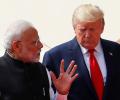
Delhi's appeasement strategy may now translate as more mega arms deals with the US, generating substantial business and job creation in the American economy. Make no mistake, Americans will use it to pressure India, predicts Ambassador M K Bhadrakumar.

It is not just the secondary market that is witnessing a revival in fortunes. Even the initial public offering (IPO) market have roared back to life, with investors submitting bids worth over Rs 2.2 trillion on the three IPOs that wrapped up on Friday. Fashion retailer Vishal Mega Mart (VMM)'s IPO (fifth largest of the year) garnered 27.3x subscription, with bids exceeding Rs 1.6 trillion.

The RBI has changed the way it approached supervision in the past. Having seen a couple of collapses in the NBFC sector and the near-collapse of a few banks, it is focusing on regular drills to prevent a fire from breaking out, explains Tamal Bandyopadhyay.

'Today, let us reaffirm our commitment to strive to realise Gandhiji's dreams. His watchwords, truth and nonviolence, will continue to remain relevant for the whole world. He also taught us that rights and duties are but the two sides of the coin - indeed, the true source of rights is duty. Today we recall his lessons in compassion too - compassion not only for our human neighbours but also for our other neighbours, namely, flora and fauna, rivers and mountains.'

The cheque truncation system, which is currently operational at the major clearing houses of the country, has stabilised well and it has made large efficiency gains: RBI
Nearly two million e-mandates for recurring payments have been registered with banks and card networks after the Reserve Bank of India (RBI) made it mandatory from October 1 to take prior consent of a customer before debiting her account, sources in know of the matter said. Industry estimates peg the recurring transactions at approximately 2.5 per cent of the total volume of transactions, and about 1.5 per cent in terms of value. Of these, around 75 per cent of domestic recurring transactions, and about 85 per cent international recurring payments are below Rs 5,000.

Wipro will be implementing the core banking solution for Paytm.

The Reserve Bank of India (RBI) on Wednesday proposed to make interoperability mandatory for digital payments firms. It also allowed users to withdraw cash from e-wallets and fintech companies to process RTGS and NEFT transactions. The RBI expressed dissatisfaction over prepaid payment instruments' (PPIs') failure to migrate towards full-KYC (know your customer) PPIs, and therefore interoperability, even two years after guidelines were issued.

President Droupadi Murmu addressed both Houses of Parliament, highlighting the government's achievements in various sectors, including economic growth, social welfare, and infrastructure development. She emphasized the government's efforts to lift the economy out of "policy paralysis" and create a more inclusive society. Murmu also acknowledged the challenges posed by digital fraud and cybercrime and stressed the need for a social infrastructure revolution. The President's speech is considered a policy statement, outlining the government's vision and roadmap for the future.

Concerned over inflationary pressures in the economy, the Reserve Bank of India (RBI) is bringing down surplus liquidity in the system rapidly. It has fallen to pre-Covid levels and almost 2 per cent of banks' net demand and time liabilities (NDTL). NDTL shows the difference between the sum of demand and time liabilities (deposits) of a bank (with the public or the other bank) and the deposits in the form of assets held by the other bank.

Fintech firm MobiKwik on Monday filed a draft red herring prospectus (DRHP) with the markets regulator, Securities and Exchange Board of India (Sebi), for its initial public offering (IPO). According to its DRHP, the company plans to raise Rs 1,900 crore, which includes a fresh issue of Rs 1,500 crore and an offer for sale of Rs 400 crore. The selling shareholders include American Express Travel, Bajaj Finance, Cisco Systems and Sequoia Capital India, besides founder Bipin Preet Singh. MobiKwik is the latest among tech majors wanting to list on stock exchanges. Food delivery start-up Zomato will launch its IPO on Wednesday.

The Reserve Bank of India (RBI) on Monday directed banks and non-banking financial companies (NBFCs) offering gold loans to thoroughly review their policies, processes, and practices to identify any gaps. The central bank also told them to closely monitoring their gold loan portfolios amid significant growth observed in this segment vis--vis some lenders. Additionally, the RBI, through a circular, instructed these lenders to ensure adequate controls over outsourced activities and third-party service providers.

The Union government is expecting to rake in Rs 100-200 crore in additional revenue from Pillar Two, only under specific circumstances, a senior finance ministry official said requesting anonymity. It is proceeding cautiously, and is unlikely to implement rules anytime soon, the source said.

The central bank gave 11 entities licences to start payments banks.

Last November, ED conducted searches under the provisions of the PMLA at nine locations in Telangana.

In order to further enhance customer convenience, and to leverage the 24x7 availability of real-time gross settlement (RTGS), NACH which is currently available on bank working days, is proposed to be made available on all days of the week effective from August 1, 2021, RBI's Shaktikanta Das said.

'I had to persuade him. I think he was a sceptic to begin with, but later on he was convinced that what we were doing was the right thing to do, that there was no other way out.'

The proposed Central Bank Digital Currency (CBDC) to be issued by the Reserve Bank will play a critical role in improving the speed of transactions and reducing the cost of cash, a Deloitte report said on Wednesday. The Reserve Bank of India is planning to come out with a central bank-backed digital currency, using blockchain technology in 2022-23. As a financial services innovation, CBDCs are likely to play a pivotal role in shaping the 'future of value transfer', the report said, adding that most central banks worldwide are now in various stages of their evaluation of launching their national digital currencies.
The idea is to keep the RBI's information technology (IT) infrastructure in top shape to run the payments and settlement system uninterrupted 24x7, and run the full gamut of RBI functions from the secured data centres, as nearly 14,000 RBI staffers, except the senior-most management, work from home.

All sectoral indices ended lower. BSE Telecommunication tanked 2.18 per cent, metal (1.77 per cent), auto (1.70 per cent), energy (1.64 per cent), oil & gas (1.59 per cent), commodities (1.39 per cent) and financial services (1.37 per cent) were the major laggards.

Switching to the UPS could be a game-changer for your retirement planning, especially if you value guaranteed benefits and higher government contributions, observes Ramalingam Kalirajan.
The eighth Budget of Finance Minister Nirmala Sitharaman continued to focus on 'GYAN' (Garib, Youth, Annadata, Nari) to maintain a consistent and coherent strategy initiated over the years in pursuing the government's vision for Viksit Bharat. The approach, characterised by incremental yet impactful steps, aims to create a compounding effect over time.

Since the first Aadhaar number was issued in September 2010, more than 1.33 billion Aadhaar cards have been generated till June 2022. With the Aadhaar enrolment of adult Indians nearing 100 per cent, the main objective of the Unique Identity Authority of India (UIDAI), which was to give Unique Identification numbers (UID) to all residents of India, is almost achieved, said a senior government official. "Enrolment will now be much more update-based, because people keep updating their mobile numbers and addresses.
